

— Newsletter Archive: Newsletter Vol. 2, 2023/9/15 —

Introducing some examples of how the warehouse management solution “HAKO-FLO” is used to streamline manual tasks such as “inbound/outbound management,” “inventory management,” “stocktaking management,” and “documentation,” including cargo damage reports.
Following the introduction of “EZ-report” in the last newsletter, we will now introduce a case study on how “RFID Query” can be used to improve operational efficiency without modifying existing systems.
PAT.P

Improving operational efficiency with RFID

1) Challenges in Warehouse Operations
“RFID Query” is an application with matching and collation functionality, which provides a solution to improve operational efficiency for various issues such as listed below:
- Workload is heavy due to visual inspection of each shipment
- Workers cannot read the Japanese on packages, which causes shipping inspection errors
- Workers spend long hours in the refrigerated warehouse visually inspecting some products, which places a heavy burden on the workers
- Much time is spent going back and forth between the office and the warehouse
- Inventory taking is time-consuming
- Time-consuming to search for mislocated goods
- High turnover of workers, and inconsistent work levels among workers
- Soaring labor costs
2) Preparation for RFID
In order to fully utilize RFID, it is important to verify the accuracy of RFID tags attached to the target packages in advance to see how accurately they can be read. There are various types of RFID tags, and it is necessary to select the most appropriate tag based on understanding of the work environment at the site and the target cargo. (Figure 1)

In addition, the process of attaching RFID tags occurs in the work process, and it is important to devise a way to prevent tag attachment errors without significantly affecting the existing work process.
Once the RFID tag to be used is determined, the necessary information is printed and encoded on the RFID tag using a dedicated RFID printer, and the tag is attached to the target packages.
3) Toward Implementing RFID in Warehouse Operations
In addition to understanding operations and RFID features, extensive implementation experience is essential to maximize the benefits of RFID use with minimal impact on existing operations.
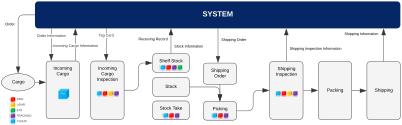
“RFID Query”, one of the HAKO-FLO services developed and provided by TOKYO ELECTRON DEVICE AMERICA, uses RFID reader handy devices and can be used in a wide range of applications, from receiving and receiving inspection to shipping inspection in general warehouse work processes. (Figure 2)
In our next newsletter, we will discuss picking and shipping inspection in warehousing operations and inventory scenarios. Please stay tuned.
To Inquiry Page
