

— Newsletter Archive: Newsletter Vol. 3, 2023/10/18 —

Introducing some examples of how the warehouse management solution “HAKO-FLO” is used to streamline manual tasks such as “inbound/outbound management,” “inventory management,” “stocktaking management,” and “documentation,” including cargo damage reports.
In our last newsletter, we introduced some of the challenges in warehouse operations and how to prepare for the use of RFID technology.
In this issue, we would like to introduce the scenes of picking, outgoing inspection, and inventory in warehousing operations as examples of how “HAKO-FLO RFID Query”, which improves operational efficiency by utilizing RFID technology, can be used to improve operational efficiency without incurring the cost of modifying existing systems.
PAT.P

Improving operational efficiency with RFID

Operation
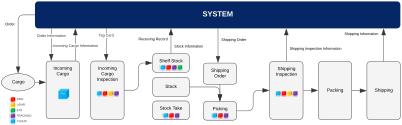
After attaching RFID tags to the target cargo, the RFID reader terminal equipped with the “RFID Query” application is used to perform the actual operation. The system can be used for a wide range of general work processes, from receiving and receiving inspection to shipping inspection. In this issue, we will introduce picking, shipping inspection, and inventory scene. (Figure 1)
(1) Picking and shipping inspection
The shipping list (CSV file) output from your WMS (Warehouse Management System) is imported into the RFID reader terminal, and the picking target is selected on the reader terminal side. After picking the cargo to be shipped from the shelves, the reader scans the picking target, and the results are instantly displayed on the screen to verify that the picking target is correct and that the required number of items have been scanned. By referring to the verification results, workers can confirm that they are not picking the wrong items, or picking more or less than the required quantity, without having to visually check each shipment. As a result, it is possible to prevent incorrect shipments and reduce work time. (Figure 2)

(2) Inventory
The inventory list (CSV file) output from your WMS is imported into the RFID reader terminal, and the area (shelf) to be inventoried is selected on the reader terminal side. When the reader terminal scans the inventory on the target shelf, the results of verification are instantly displayed to confirm that the inventory target cargo in the selected area (shelf) exists on the list. The results are instantly displayed, allowing you to check whether the inventory list and the quantity of the cargo actually on the shelves match, without having to check each item individually. This can lead to a significant reduction in work time, increase the number of inventory counts, and improve the accuracy of inventory quantity control. In addition, the use of long-range RFID reader terminals makes it possible to check cargo from ground level without having to climb to a high shelf, such as 10 meters above the ground, thus contributing to worker safety.
(3) Cargo search
The RFID Query application has “Cargo Search Mode” that uses the strength of radio reception from RFID tags. The RFID reader can search for cargo that is not in the location specified by your WMS (Fig. 3). Compared to the conventional method of searching for cargo based on intuition and experience, this system can significantly shorten the search time.

By utilizing “HAKO-FLO RFID Query” with these features, the issues could be resolved as follows:
Issue 1: Workload is heavy because each item is visually inspected and matched one by one
-> Batch matching by RFID shortens the inspection time and reduces the workload of workers.
Issue 2: Japanese on packages is unreadable, resulting in shipping inspection errors
-> Data matching functionality prevents inspection errors even if the text is unreadable.
Issue 3: Long hours of visual inspection work in refrigerated warehouses is burdensome
-> Batch matching by RFID shortens the work time and reduces the workload.
Issue 4: Many workers spend a lot of time traveling back and forth between the office and the warehouse
-> The same work can be performed by anyone, so work can be completed at the warehouse site.
Issue 5: Workers are frequently replaced, and the work level is not stable
-> The same work can be done by anyone, so the quality level is stable.
Issue 6: Soaring labor costs
-> Curbing labor costs and overtime expenses by improving efficiency through shortened working hours.
Issue 7: It takes time to search for misplaced items
-> Search mode function reduces search time
In our next newsletter, we will discuss the use of the HAKO-FLO CLOUD Service in warehousing operations. Please stay tuned.
To Inquiry Page
